What Is The Functional Founder™ Framework?
In my last post, I introduced 3C²™: the Confidence, Competence and Capacity gap holding women in business back, and the three Cs that fix it. I promised to come back and unpack the framework that sits underneath it, The Functional Founder™ Framework, the one we’re building everything at Athena Collective around.
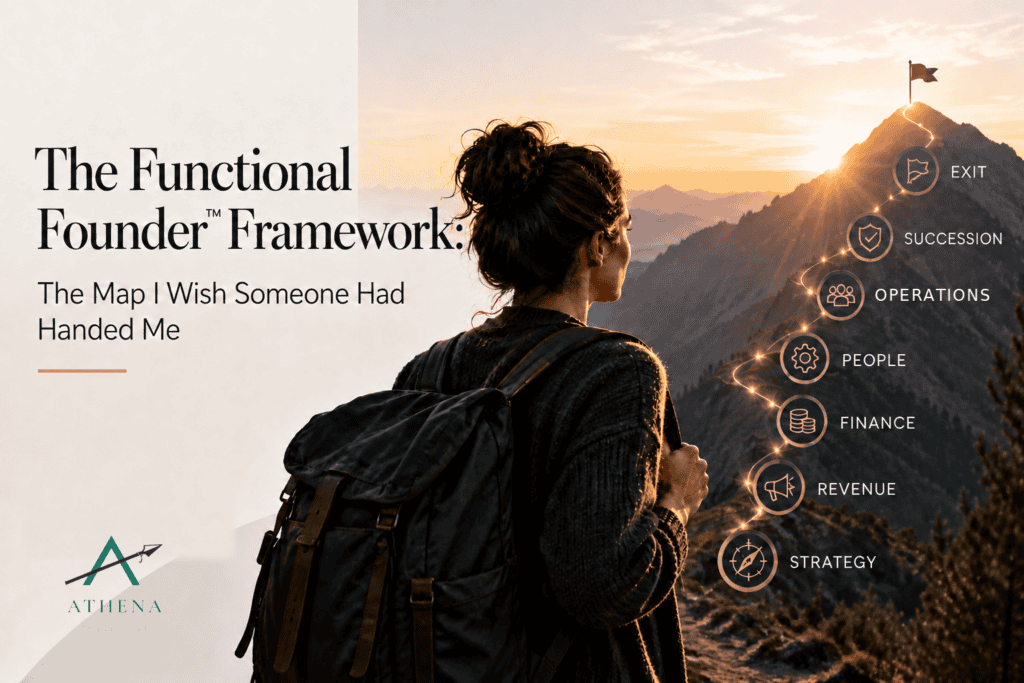
The short version: The Functional Founder™ Framework is a map of seven pillars, 35 competencies and more than 200 skills that shows a female founder where her business stands and what to strengthen next, so she can build, scale and exit a company on a clear path instead of by guesswork.
The longer version starts in the dark. Because the framework wasn’t born in a strategy session. It was born from what it actually felt like to build a company with no map at all.
What building in the dark actually looked like
There’s a version of my founder story that sounds inspiring. I’ve told it on stages: started at 28, six months pregnant, broke after walking away from a bad business relationship, and built a global agency that we eventually sold. All true.
Here’s the part that usually gets left out.
I didn’t know where to get funding, or if I could even qualify for it. I didn’t know when to hire. I didn’t know who to hire first, or how I was going to afford them. I didn’t know what to invest in first. Or second. Or third. I lay awake at night running those questions in circles, and in the morning I guessed. Some guesses worked. Many didn’t. The ones that didn’t cost me money I didn’t have, and time I could never get back.
I did it the hard way. I made costly mistakes, and time-sucking ones, and I wasted months. Honestly, some of them cost me years. Fifteen years of nonstop hustle later, standing in a successful exit, I still couldn’t wrap my head around why it had to be that difficult.
And the physical cost. I took five days off when my daughter was born, then went back to 60-70 hour weeks. I ran my life around my babies’ sleep schedules for years, working and being with then when they woke and sleeping when they slept. About four or five hours a night for years. Half the time I forgot to eat properly, or ate standing up at the counter with a phone at my ear, rocking a baby in my arms. I’m not telling you this like it was noble. It wasn’t. It was burnout in slow motion, and I know I’m not the only one who’s lived it. In Going It Alone, a study of business owners by the Canadian Mental Health Association and BDC, 41% of women entrepreneurs reported burnout compared with 29% of men, 74% reported fatigue, and 64% reported disturbed sleep. Those numbers aren’t just statistics to me. They’re a memory.
The scariest part wasn’t the things I didn’t know. It was the things I didn’t know I didn’t know. The unknown unknowns. I didn’t know what questions to ask, so I couldn’t even Google my way forward. I didn’t know who to turn to, because I didn’t know what kind of help existed. I just knew I was a smart, capable woman who was white-knuckling it, so I just put my head down and kept going. For years. Looking back, I thought, “what was wrong with me?”
Nothing was wrong with me. I was a driven young entrepreneur who was missing a map.
The real problem: there was nowhere to go
Here’s what I kept wishing for, through every stage of that journey.
I wished there was somewhere safe to go. A place with people like me, who were going through it too, who could tell me what to do next. Who could make that one introduction that would have saved the day. Who could give me guidance on the one thing holding me back that week, instead of another course I didn’t have time to finish or event I didn’t have time to go to. I needed a place where I could show up as my real, raw, beat up, but so determined self, and not get judged for it. Where I could ask the “dumb questions” I’d been hiding for years because I thought the CEO had to be the strongest and smartest person in the room.
I looked for that place from the beginning to the end of my journey, holding together my family, my business and myself, and it didn’t exist. There was help everywhere, but none of it knew me, and none of it met the needs of my entire situation. A course here, a networking event there, a friend of a friend who did books, a startup group for beginners. I was spending my energy hunting for support instead of building my company.
If you’ve ever felt that way, I want you to hear this clearly: you are not doing it wrong. The support is scattered, and you were never meant to assemble it all yourself.
That’s the real reason we started Athena Collective. I retired from agency life the day after my 44th birthday, took 48 hours off, and then got to work building this company with my co-founders Mikayla Stewart and husband Iain, because I understood that the thing I spent 15 years wishing for was the thing I was supposed to build. I felt like I suffered through it, and I didn’t want one more woman on the planet to have to do the same.
What is The Functional Founder™ Framework?
So how do we fix the dark? We built the map.
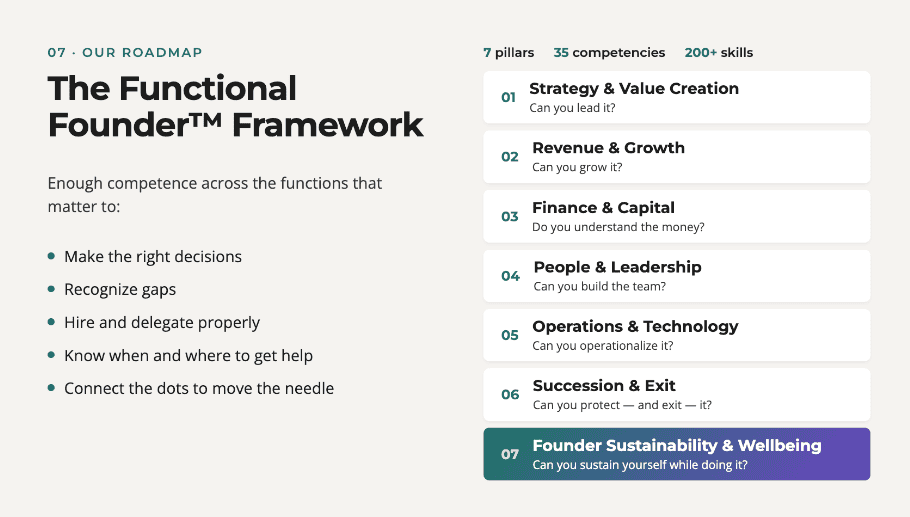
The Functional Founder™ Framework is seven pillars, 35 competencies and over 200 skills that get a female founder, owner or operator to a baseline of functional literacy in every area of her business she needs to understand. Not mastery. Functional literacy.
That distinction is the whole idea. You don’t need to become the accountant, the lawyer, the head of sales and the CMO. You need to know enough about all of it to spot the issue, ask the right questions, and know when to learn it, delegate it, or bring someone in. You don’t need to be an accountant to read a P&L. You need to read a P&L well enough to talk to your accountant.
Enough competence across all the functions that matter. To make the right decisions. To recognize gaps. To hire and delegate properly. To know when and where to get help. To connect the dots and move the needle. To do it with people going through it with you, or who have already done it, so you can go faster and the journey gets easier.
Here’s what I’ve seen across hundreds of founders: a woman who is roughly 20% capable across all the areas of her business has a far better chance of building something successful than a genius in one lane who’s blind in the rest. Competence across the whole map beats perfection in one corner of it. That’s the difference between a founder who gets surprised and a founder who sees it coming. It’s also the difference between a founder who gets acquired and a founder who does not.
And here’s what makes it a path instead of a checklist. The framework meets you where you actually are: your tools, your strengths, your goals, your needs, your challenges, your industry, your audience. You’re not the founder next to you. Your next right move may not be hers. So your path through the framework isn’t either.
The seven pillars, in plain English
Every business, at every stage, needs attention in seven areas. Here they are the way we lead people through them, each one with the question it’s really asking:
- Strategy & Value Creation. What problem do you solve and why? What you sell, who it’s for, and why it matters to them.
- Revenue & Growth. Can you grow it? Knowing your best customer, getting in front of new people, selling and pricing in a way that doesn’t depend on how you feel that day.
- Finance & Capital. Do you understand the money? Cash flow, margins, funding options, and knowing the month you’d run out if nothing changed.
- People & Leadership. Can you build the team? When to hire, who to hire, how to afford them, and how to lead people without becoming the bottleneck.
- Operations & Technology. Can you operationalize it? Systems, processes and tools, so the business can exist beyond your memory and your hours.
- Succession & Exit. Can you protect it, and exit it? Legal, risk, and planning for growth, succession or exit, on purpose instead of by accident.
- Founder Sustainability & Wellbeing. Can you sustain yourself while doing it? The person behind the business. Your health, your energy, your family, your peace of mind, your life. Because if you’re not well, what was it all for anyway.
Notice that last one. It took me decades to learn that it’s a pillar and not a luxury. We put it in the framework so you don’t have to learn it the way I did.
The pillars don’t change from founder to founder. What changes is where you stand on them, and what you need next. That’s the difference between a framework that sits in a book and a framework that works.
How this ties back to 3C²™
If you read my last post, you know the pattern: 3C²™ says women are held back by Confidence, Competence and Capacity, that we fix those through Consolidation, Curation and Connection, and that we get Clarity, Capital and Control as a result.
The Functional Founder™ Framework is the Competence half of that equation, made real. It answers the question the three Cs raise: competent in what, exactly? Now you know. Seven pillars, 35 competencies, 200+ skills, and an honest picture of where you stand on each one today.
And Competence feeds Confidence. When you can see your baseline, name your gaps without shame, and know your next three moves, the fear of the wrong move quiets down. You stop second-guessing and start executing. That’s Clarity. And clarity, acted on, builds Capital and Control, which feed straight back into Capacity. The flywheel I described in the 3C² post only spins if there’s a map underneath it. This is that map.
What it removes
We built this framework to take specific things out of a founder’s life, because I remember exactly how much each one weighs.
The guessing. The pain of learning everything the hard way. The wasted money on the wrong thing at the wrong time, and the wasted months and years doing it the hard way. The loneliness of being the only one carrying it. The exasperation of working that hard for answers that should have taken one conversation. And the burnout that comes from treating a capacity problem with more effort.
You will still work hard. You will still make mistakes. That’s business. But you don’t have to make the avoidable ones, the ones someone else has already made for you, and you don’t have to make them alone.
Questions founders ask about The Functional Founder™ Framework
Do I need to be an expert in everything to run a business?
No. You need functional literacy: enough knowledge in every area that matters to spot problems, make informed decisions, ask good questions, and know when to bring in expertise. Deep skill in one or two strengths, a working baseline everywhere else.
Who is the framework for?
Women who own, operate or are starting a business, at any stage. It maps to three stages, build, scale and exit, and the competencies that matter most shift as you move between them.
How is this different from a course or a coach?
A course gives you content. A coach gives you advice. The framework gives you a map of your whole business, and the platform built on it curates the right resource, person or next step for where you actually stand, with a community to back you up and cheer you on.
How do I know where I stand on the seven pillars?
There’s a free assessment on the Athena Collective platform: 35 questions, about four minutes, and you’ll see your baseline across all seven pillars, what’s in place, what’s taking shape, and what matters next for you. Your answers stay yours.
You don’t need to know everything. You need to know enough about everything that matters, and you need people beside you who’ve been where you’re going.
I spent fifteen years finding my way in the dark so you don’t have to. The map exists now. Let’s get you moving. There is a better way forward.
Sarah