It was never about empowerment.
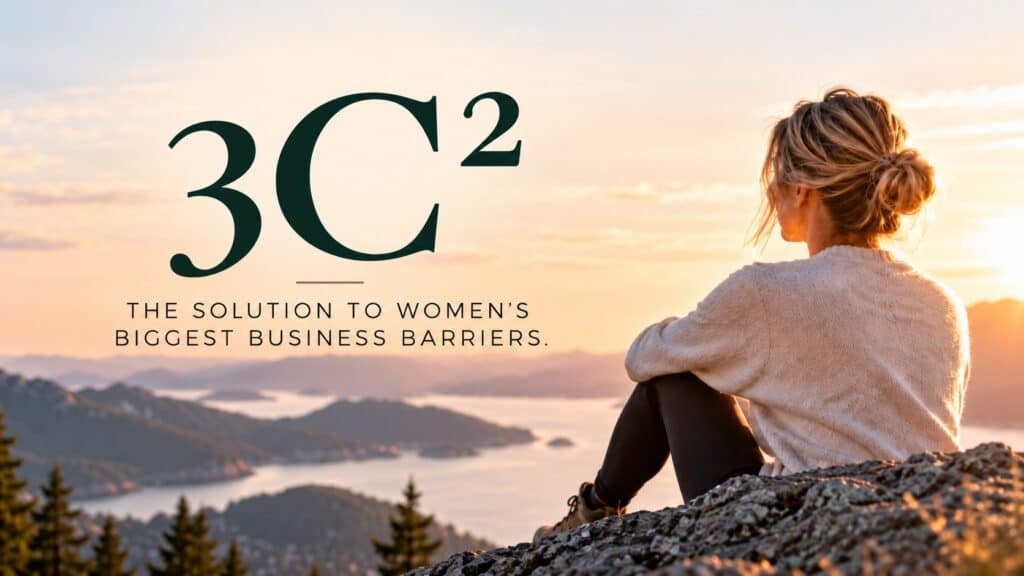
Women don’t have a power problem. We have a 3C problem.
I’m a five-time founder. I’ve built, scaled and exited more than one company, including All Inclusive Marketing, which I started at 28 years old, six months pregnant and completely broke after walking away from a bad business partnership. Fifteen years, a global team, a pandemic and about a thousand pivots later, we exited through a successful mid-market acquisition to Plus Company.
So when I say I understand the pains, I mean it. I’ve lived them. I’ve signed contracts from my hospital bed the day my daughter was born and then took five days off before I was back at my desk working 60-70 hour weeks. I hid needing help for years because I thought the CEO had to be the strongest and smartest person in the room. I see the same pains around me every single day, in the women I mentor, the founders in our community, and the women who come up to me after I step off a stage.
Here’s what I’ve learned: it’s not empowerment or options that hold us back. We have the power. We are fully capable of working hard, figuring it out and solving problems. What keeps us from advancing and elevating our businesses faster is something more specific. It has a shape. And once I saw it, I couldn’t unsee it. And I finally understood how to fix it.
I call it 3C², and it sits at the heart of The Functional Founder™ Framework we’re building at Athena Collective. This post goes deep on 3C², what it means and why it’s a way forward for women in business everywhere.
My next post will unpack the full Functional Founder™ Framework and the seven pillars we need to focus on in order to build, scale and exit successful companies, but for now, let’s dig into 3C².
Where 3C² came from
3C² didn’t come from a whiteboard session. It came from me reflecting on my own journey as a woman in business, having built, scaled and exited a multi-million dollar company, asking why the 15 year journey to do so felt so hard.
It came from the thousands of conversations I’ve had with women in business, my own observations about what’s happening in the world, and truly listening to the pain points and roadblocks that are consistently in our way.
When my co-founder Mikayla Stewart and I started comparing notes, she was seeing women she’s consulted over the years hitting the same walls. When we dug deeper into our members’ questions, I noticed a pattern, and they almost always came back to the same three things.
We looked at the data further, and it reinforced why we started this company in the first place. Most women-owned businesses haven’t reached $100,000 in revenue, and only a tiny fraction ever hit seven figures. That’s not a talent gap. That’s something else.
When I finally mapped every barrier I’ve lived and heard about and compared our notes and data with each other, I realized that each one fell into one (or several) of three very specific categories.
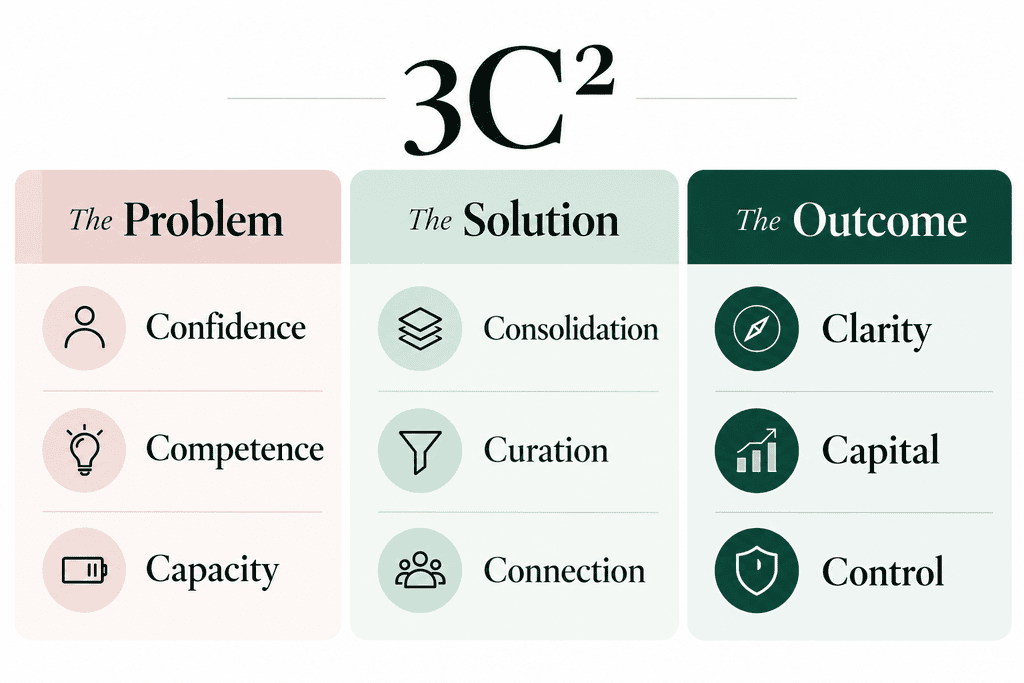
Solve those three C problems with three more Cs, and you get three C results. Three Cs, squared:
- The Problem: Confidence, Competence, Capacity
- The Solution: Consolidation, Curation, Connection
- The Result: Clarity, Capital, Control
And the results feed straight back into fixing the problem, so the cycle keeps pushing us forward instead of holding us back.
The Problem: Confidence, Competence and Capacity
Let’s start with the numbers, because they tell the story we live. In the U.S., women own millions of businesses, yet only 1.9% of women-owned businesses reach $1 million or more in revenue, according to Wells Fargo’s 2025 Impact of Women-Owned Businesses report. The JPMorgan Chase Institute found that among businesses starting under $100,000 in revenue, just 0.6% of women-owned firms reach $1 million, compared with 1.4% of men-owned firms.
That gap doesn’t come from a lack of ambition or ability. It comes from three things that feed each other.
Confidence: imposter syndrome, the unknown unknowns, and the fear of the wrong move
When I built my last company, I had an identity crisis. I came from a corporate background and now I was this self-proclaimed CEO of my own company. I believed I needed to have every answer, and be the smartest person in the room to be taken seriously. I couldn’t let anyone see that I didn’t know much about running a business yet. So I hid needing help or having “dumb questions” for far too long. The day I let go of this belief, let my ego go and went to find the best talent to fill my gaps, started asking the right questions, and was honest about my skills, experience and knowledge gaps, was the day my company finally took off.
I’m not alone. A KPMG study of 750 high-performing executive women found that:
- 75% have experienced imposter syndrome in their careers
- 85% believe imposter syndrome is common among women in corporate America
- 74% believe their male counterparts don’t feel as much self-doubt
- 56% fear they won’t live up to expectations
These are women one or two steps from the C-suite. Many of these women are leaving corporate life to become entrepreneurs or consultants. Now picture the founder with no boss, no roadmap and nobody to tell her if she’s on track.
And it doesn’t go away when you become the boss. In Going It Alone, a study of business owners by the Canadian Mental Health Association and BDC, 60% of women entrepreneurs reported feelings of uncertainty or inadequacy, compared with 46% of men.
Harvard Business School professor Katherine Coffman’s research shows that even when women and men have the same qualifications, women are less likely to put themselves forward, especially when the criteria are ambiguous. And entrepreneurship is nothing but ambiguity.
That’s where the unknown unknowns live. We don’t know what question to ask. We don’t know what we’re missing. We have blind spots everywhere, but we’re often too afraid to ask because we don’t have a safe space to land, and we don’t want to appear weak. So we either make a move and pray it works, or we do nothing at all because we are too afraid of failure, rejection or self-doubt to move. It feels like half of us are white-knuckling it, and the other half of us are burning out in the process. Both cost us time, money and momentum towards building a thriving business and life.
Competence: missing skills, knowledge and experience
Let me be really clear. When I say competence, I don’t mean we are incapable. Competence is defined as the ability to do something successfully and efficiently through the required knowledge, skills, and practical application. It’s built through reps and access, and historically, women haven’t had the same opportunities or access.
In the U.S., it wasn’t until the Women’s Business Ownership Act of 1988 (H.R. 5050) that state laws requiring a woman to have a male relative co-sign her business loan were eliminated. That’s within my lifetime. We are building on a much shorter runway.
So many of us are brilliant at the thing we started our business to do, and then we’re suddenly expected to be the CFO, the head of sales, HR, legal, operations and IT, with no prior experience. Sometimes we don’t even know the vocabulary to use to ask for what we need, know what we even should need, or ask the right questions to the right people to move forward in a way that advances us. Plus it’s scary to ask questions in rooms where you feel judged.
And the skills we need keep moving. In Canada, only 12.3% of women-owned businesses use AI, compared with 16.5% of men-owned businesses, according to the Women Entrepreneurship Knowledge Hub’s State of Women’s Entrepreneurship in Canada 2025 report. Every new tool we don’t have time to learn widens the gap.
What we need to understand is that knowing and embracing your competency level today isn’t a judgement. It’s a baseline. It’s a reality check that tells you where to build and grow next, both personally and professionally.
Capacity: mind, body, soul and time
This is the one nobody understands fully, because it’s different for everyone, but every woman I know feels it.
Women are juggling babies, homes, partners, aging parents, and very often a full-time job while we build a business off the side of our desks. According to UN Women, women do 2.5 times more unpaid care work every day than men, and 45% of working-age women are kept out of the labour market by care responsibilities, compared with 5% of men.
For many of us, that load is the reason we started a business in the first place. According to Gusto, 28% of U.S. women with school-aged children who started a business in 2021 did so because of increased childcare responsibilities, and in 2022, 64% of new women business owners cited the need for flexibility.
And we’re running on empty. In corporate America, McKinsey and LeanIn’s Women in the Workplace 2021 report found 42% of women were burned out, compared with 35% of men. For founders, the gap is even wider. Going It Alone found 41% of women entrepreneurs report burnout, compared with 29% of men. 74% report fatigue (vs 54% of men) and 64% report disturbed sleep (vs 48%).
I took five days off when my daughter was born. I followed my babies’ sleep schedules for years, working when they woke and sleeping when they slept, about four or five hours a night (because I had two). That’s what it took to get my business ahead.
When we’re physically and mentally exhausted at the end of the day, we don’t have the capacity to go learn the skills that build competence, which is what builds confidence and helps us make better decisions about how to move forward. And so the cycle repeats. It’s not a character flaw. It’s a system that wasn’t built for us. That’s why having one platform that brings the ecosystem together, in a way that is designed by us, for us, is so imperative.
The Athena Collective Solution: Consolidation, Curation and Connection
So how do we fix it? Not with another pep talk. Not with more “empowerment”. We have the power. We need structure, personalization, a safe space to work on our business, not just in it, and a clear next step forward. And I’m not talking just in the beginning, but at every stage of the entrepreneurial journey as we build, scale, and exit successful companies.
Consolidation: the best resources, tools and people in one place
Here’s what I’ve noticed. There is a ton of help out there for women in business. Programs, tools, communities, partners, funding options, courses. There’s also a lot of garbage and even more noise. So nobody has the time or capacity to go find it all, vet it, and figure out what works, what doesn’t, and understand what to do with it.
So we do that work for you. At Athena Collective, we bring the best resources, tools, programs, community partners, solutions and people into one place, so you can stop wasting time and energy searching and start moving forward. Consolidation gives you back the time and energy capacity you were spending on the hunt, which you can then use to build your knowledge base, business strategy and useful connections, moving you forward faster.
Curation: only what matters to you, at this moment
You are not the founder next to you. You’re in a different industry, a different business stage, with different goals and different roadblocks. Your life looks different from every person standing around you. Therefore, a one-size-fits-all curriculum or program just adds to the noise, and that’s what most people are finding out there.
When you join Athena, we get to know you as a person, as a founder, owner and operator, as well as your business. You tell us your goals, challenges, where you’re struggling, who you’re selling to, what industry you’re in, and what stage of business you’re at. We learn your baseline skills in different areas of business. That’s how the platform curates what you see.
Our Co-founder & CTO Mikayla Stewart built the platform on what we’ve experienced as successfully exited founders, and learned from interviewing hundreds of founders going through it too, so it surfaces what actually matters to you right now (in this moment in time) and flags what you should look at next. This helps you move faster and take out the guesswork, which gives you the capacity to work on what you need.
This is how we are solving the unknown unknowns. You don’t have to guess the right question anymore. You don’t have to stay blind to the gaps you can’t see. You don’t need to go digging for that next resource. We show you, and we keep it simple so you’re never overwhelmed with too much information. You just know what to do next.
Connection: your next step, every week
The last C connects you to the next piece: the next person, the next resource, the next action. Each week, you get suggested next steps and action items to execute on, so you can move from A to B faster and without all the mistakes we have already gone through as business owners.
That consistency matters. SCORE surveyed 20,000 U.S. small business owners and found that entrepreneurs with mentors are five times more likely to start a business, and 43% of owners with five or more mentoring sessions reported growth, compared with 30% after just one. Support works best when it keeps showing up.
Connection is also about people. Research from Northwestern’s Kellogg School of Management, led by Brian Uzzi, found that women with a strong network and a close inner circle of women landed leadership positions with an average job ranking 2.5 times higher than women without both. As Uzzi put it, women need that inner circle for the “private information to understand how to negotiate within a world where you’re being held to different standards.” The same is true for women in business. We need a strong community of women around us, who understand business and have or are currently going through it too.
I’ve watched this happen in our own community. One of our not-for-profit members who founded Universal Limbs, whose company 3D-prints prosthetic limbs for victims in high conflict zones, posted in our member Slack that she needed help fundraising to get her team to Egypt to support and fit people with prosthetics there. Two members on the other side of the country, who run a PR firm called That Tracks Content, saw it and stepped in. They landed her an 11-minute feature on national news. She raised enough money to send her team, including nurses and consultants, to help people in need. That one post in our Slack channel, answered by two members across the country, helped hundreds of people on the other side of the world. Imagine the ripple effect of that. That is the power of connection in action.
The Result: Clarity, Capital and Control
When we consolidate what’s out there, curate it in a way that’s meaningful and actionable, and connect to the right next step, three things change.
Clarity: what to do next, and the way forward
Clarity is the antidote to the unknown unknowns. Remember Coffman’s finding: ambiguity is exactly where self-doubt creeps in. Take away the ambiguity, and you take away a lot of the fear.
When you know your baseline, your gaps and your next three moves, you stop second-guessing and start executing. Clarity is a road forward, and every step you take on it builds confidence.
Capital: cash flow and value that build strength and scale
Women are not a risky bet. We’re an under-resourced one, because our resources and time are scattered. In 2024, all-female founding teams received just 1.9% of U.S. venture capital dollars, according to PitchBook. That’s down from 2.7% in 2023. Yet Boston Consulting Group found that women-founded startups generated 78 cents in revenue for every dollar invested, compared with 31 cents for startups founded by men.
And most of us aren’t raising venture capital at all. We’re borrowing. Or we’re self funding. Yet only 24% of women-owned businesses receive the full loan amount they apply for, compared with 41% of men-owned businesses, according to the Federal Reserve’s 2023 Small Business Credit Survey, as reported by NORC at the University of Chicago.
And when women do break through, we grow. Between 2019 and 2024, the number of million-dollar-plus women-owned employers grew 9.9%, compared with 1.3% for men-owned firms, per Wells Fargo.
Clarity creates capital: better decisions mean stronger cash flow, a healthier business and more enterprise value. And capital builds confidence, because it’s proof.
Control: over your business and your life
Control is what all of this has been building toward. Control over your business means you’re making decisions from strength, not survival. Control over your life means you get to choose where your time and energy go: your kids, your health, your partner, your own growth.
And here’s the best part. Control feeds right back into the problem and starts reversing it. It builds more confidence. It frees up capacity. It gives you the room to build competence. Then you level up again.
That’s why I call it 3C². The three problems, solved by three solutions, produce three results that make the problems smaller every single time you go around. I believe this methodology is the solution to a multi-generational problem we have all been searching for.
Start where you are
At Athena Collective, we meet women where they are. No judgement. Just support, compassion, understanding, strength and a clear path forward.
You’re not behind. You’re just starting somewhere that’s new for you. Every founder, including me, started with gaps. The difference is knowing what they are and knowing what to do about them next.
That’s why the first step is our Competencies Assessment. It shows you where you’re starting from: your baseline, your gaps, and a clear path to build, scale and ultimately exit a successful company. It’s built on The Functional Founder™ Framework, which I’ll unpack in my next post.
As Justice Ruth Bader Ginsburg said, “Women belong in all places where decisions are being made.” That includes the boardroom, the cap table and the closing table of your own exit.
Let’s get there together.
— Sarah Bundy, CEO and Co-Founder, Athena Collective. Creator of 3C² and The Functional Founder™ Framework.
Sources
- Wells Fargo, 2025 Impact of Women-Owned Businesses
- JPMorgan Chase Institute, Scaling to $1 Million (April 2024)
- KPMG Women’s Leadership Study, imposter syndrome (October 2020)
- CMHA and BDC, Going It Alone: The Mental Health and Well-Being of Canada’s Entrepreneurs (2019)
- Harvard Business School, Katherine Coffman research on women’s advancement
- NAWBO, What is H.R. 5050
- Women Entrepreneurship Knowledge Hub, State of Women’s Entrepreneurship in Canada 2025
- UN Women, unpaid care work FAQ (October 2025)
- Gusto, The Rise of Women Entrepreneurs
- UNLEASH on McKinsey & LeanIn, Women in the Workplace 2021
- SCORE, Megaphone of Main Street: Women’s Entrepreneurship (2018)
- Kellogg Insight, Uzzi et al. on women’s networks (PNAS 2019)
- PitchBook, 2024 All In: Female Founders in the VC Ecosystem
- BCG, Why Women-Owned Startups Are a Better Bet
- NORC 2025 Women Business Ownership Fact Sheet (Federal Reserve Small Business Credit Survey 2023)
- Aspen Institute, Remembering Ruth Bader Ginsburg