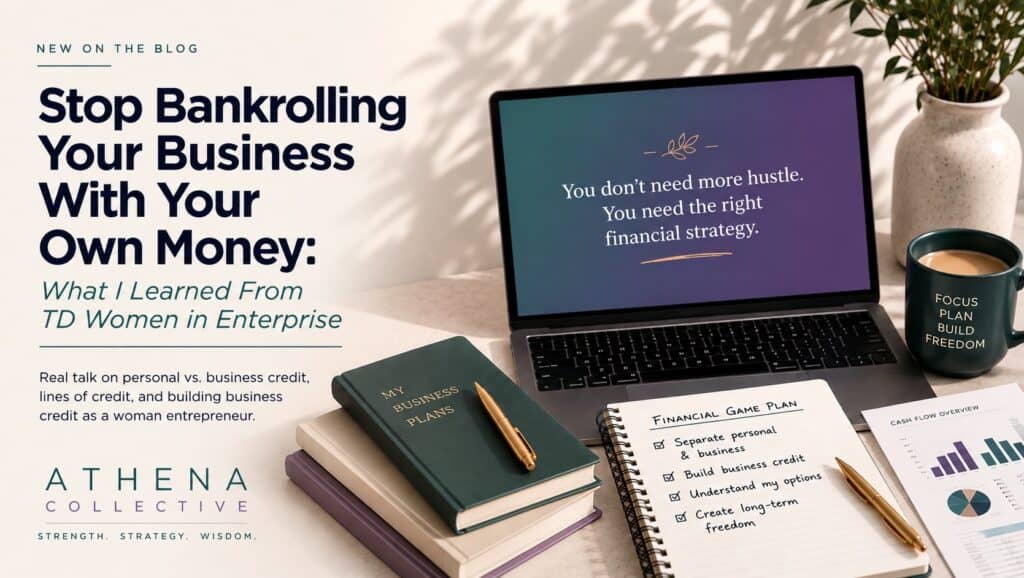
Athena Collective hosted The Open Desk: Banking + Finance Q&A, a live conversation for our community with two guests from TD Women in Enterprise: Nelofar Maleqazghar, Regional Manager, Pacific Region, and Sabeen Latif, a Business Account Manager.
Members asked questions we know a lot of us are quietly wondering about, and the answers were honest. What came out of it was one of the most useful, real-world conversations about money I’ve heard in a long time.
If you’re an entrepreneur — especially if you’re a woman who came to this later in life, or from a career where nobody ever talked about credit, mortgages, or lines of credit — this one’s for you. Here’s what we covered.
Quick takeaways
- Personal credit isn’t a safety net — it’s a hidden cost. Funding your business with savings or personal credit can quietly block you from a mortgage or other borrowing down the road.
- You don’t need to be incorporated to apply for business credit. Sole proprietors qualify too.
- Line of credit vs. loan: use a loan for a specific purchase, a line of credit for flexibility.
- Get a business credit card before your first client — it protects your personal credit and does your bookkeeping for you.
- Pre-approvals expire. If you’re offered one, take it while it’s there.
- A late payment hurts your score even if you pay in full right after. Timing matters more than the amount.
The Habit Almost Every Woman Entrepreneur Has (And Why It’s Riskier Than It Feels)
Here’s the pattern Nelo and Sabeen see constantly: women fund their businesses out of personal savings, personal lines of credit, and personal credit cards before they ever walk into a bank and ask for a business line of credit. It’s not a lack of ambition. It’s a lack of exposure to options and expertise.
Most of us were never taught how business credit works, so we default to what feels safe: our own money. Except it isn’t actually safer. It just moves the risk somewhere less visible.
When you pour personal resources into your business, you’re not just spending money — you’re using up your personal credit capacity and putting strain on your personal net worth. That has real consequences down the line: it can delay or block you from qualifying for a mortgage, a second property, or another personal financial decision you want or need to make. And it’s not just financial. Nelo was candid that TD Women in Enterprise has seen this strain show up in people’s marriages and their most personal decisions, because running a business while quietly draining your own financial cushion adds a layer of stress most entrepreneurs are already carrying alone.
Sabeen shared a story that stuck with me: a client who took out large personal lines of credit and loans to fund their business, years before their child applied for a $300,000–$400,000 student line of credit to study medicine abroad. The parents needed to co-sign. But when the bank pulled the credit bureau, there was so much existing personal borrowing — with income that hadn’t grown proportionally — that there wasn’t enough room left in the ratios to qualify the child for the loan. The business had done exactly what it was supposed to do. It just did it on the wrong ledger.
Needing credit isn’t a sign your business is struggling. It’s a sign it’s growing. Every business has capital needs. The question isn’t whether you’ll need credit — it’s whose credit profile absorbs it.
“But I’m Not Incorporated Yet” Is Not a Reason to Wait
One thing Nelo wanted every woman on the call to hear clearly: you do not need to be incorporated to apply for business credit. You can be a sole proprietor — operating under your own name or a trade name — and still apply for credit as a business. The bank will ask for a personal guarantee regardless of your structure (incorporated, sole proprietor, or partnership), so incorporation status is not the gatekeeper a lot of us assume it is.
If you’ve been telling yourself “I’ll go to the bank once I’m officially incorporated,” that’s not actually the rule holding you back.
Line of Credit vs. Loan: How to Know Which One You Actually Need
This was one of the most practical parts of the conversation. The two products solve different problems:
A loan makes sense when you have a specific purchase in mind — a piece of equipment, a one-time cost to open your doors. You get the full amount up front and start making fixed monthly payments against it.
A line of credit makes sense when you want flexibility rather than a specific purchase. It’s a limit attached to your business account. You draw on it only when you need it, and when deposits come back into the account, the balance automatically pays itself down. Nelo’s advice for anyone who wants “options” more than an immediate need — which is exactly what several of us said on the call — was to lean toward a line of credit rather than a loan. If you take a loan you don’t have an immediate use for, you’re paying interest and monthly payments on money that’s just sitting there. A line of credit only costs you when you’re actually using it.
The nuance Sabeen and Nelo both flagged: don’t let a line of credit sit untouched and unused for too long, either. Banks review these facilities annually behind the scenes, and if there’s no activity, it raises questions about whether the business has paused. The healthiest pattern is a line of credit that revolves — draw it down, pay it back through your regular deposits, use it again as needed.
What Actually Happens in Those “Recurring Meetings” With Your Banker
Someone on the call asked the question I think a lot of us have: if I don’t need anything right now, what would I even talk about with an account manager?
Nelo’s answer reframed it for me. These aren’t sales meetings — they’re touch points. Your first meeting is a discovery conversation about what your business does and what your priorities are. After that, it’s a regular check-in: what are your priorities for the business over the next three to six months, and how can your banking partner support them? Are you planning to hire? Pay off debt? Take on a new project? Expand into a new market? You don’t need to walk in with a fully formed ask. You just need to talk about what’s actually happening in your business, and let your account manager help anticipate what you might need next.
Sabeen described her own version of this as proactive calling — checking in with clients by phone, not always a formal meeting, just to ask how the business is doing, what’s coming up, what’s getting harder. Sometimes that surfaces a real need (a contract that requires a line of credit to buy materials); sometimes it’s just a conversation about weathering a slow season. Either way, the relationship exists so the bank can move quickly when you actually need it to.
And these teams are more connected across the bank than you might expect — account managers regularly bring in financial planners, estate specialists, or private banking partners once your needs get more complex. The advice here is simple: build the relationship early, especially if you know something is coming (a child heading to university, a major expansion) two or three years out.
The Real Reason to Get a Business Credit Card on Day One
If there was one piece of advice that came up over and over in different forms, it’s this: separate your personal and business finances from day one, before you even have your first client.
The reasons go beyond tidiness:
- They protect your personal credit room the same way a business line of credit does — every dollar of business spending on a personal card is a dollar of your personal capacity you can’t use elsewhere.
- They make your accounting dramatically easier. A business credit card statement effectively does your bookkeeping for you — categorized expense reports you can hand straight to your accountant at year-end. Mixing personal and business expenses on one card means manually separating twelve months of transactions later.
- They let you delegate safely. If you bring on a partner or employee, you can carve out a portion of your credit limit — say $1,000 of a $5,000 limit — onto a card in their name, rather than handing over your own personal card.
- They earn faster travel points. Business travel cards (TD mentioned their Aeroplan and Expedia-affiliated business travel cards specifically) tend to earn points faster than personal cards simply because business spending is usually higher volume — many entrepreneurs end up using those points for their own personal travel as a nice side benefit.
Sabeen’s bottom line, and it’s one worth writing on a sticky note: money in belongs in your business account, money out belongs on your business credit card. Whatever’s left over is what makes tax season important to pay attention to.
The Mistakes TD Women in Enterprise Sees Most Often
A few patterns came up when members asked what mistakes new founders make most often with banking:
Waiting too long to establish business credit. Founders who fund everything personally for too long often arrive at the bank already having used up their personal credit capacity or damaged their credit score — right when the business has grown and actually needs more, not less, borrowing power. Ironically, coming in early, even before you strictly “need” credit, often gets you a stronger facility than waiting until you’re in a cash crunch.
Assuming a pre-approval is permanent. Pre-approvals are based on your credit bureau score and your current financial and deposit activity — not a fixed offer. If your situation changes, the pre-approval can disappear. If you’re offered one and there’s any chance you’ll need it, the advice was blunt: take it while it’s there.
Optimizing your books for taxes at the expense of qualifying for financing. Nelo mentioned seeing clients whose financial statements were so aggressively structured to minimize taxable income that there was barely any income left to support a credit application when they needed one. If you know you’ll want to borrow to scale in the next year or two, that’s a conversation to have with your accountant and your banker together, in advance — not after the fact.
Best Practices for Paying Down Credit (So It Actually Helps Your Score)
I asked this one directly because I don’t think anyone explains it clearly: is it better to pay the minimum, or pay it off in full?
Paying your balance in full each month is the ideal — it shows the business is healthy and using credit responsibly. But if you can’t pay in full, the critical thing is paying at least the minimum on time, every time. A late payment — even by a few days — gets reported to the credit bureau as a late payment, permanently, even if you pay the full balance shortly after. The reporting is automated and it doesn’t care about context.
For a line of credit specifically, the goal is to keep it revolving rather than either maxing it out and sitting there, or leaving it completely untouched. Lines of credit get reviewed annually, and a maxed-out balance with no repayment activity raises real concerns about cash flow, while a completely dormant one raises questions about whether the business is still active. Draw it down, pay it back through your regular deposits, and use it again — that pattern is what a bank wants to see.
One structural tip from TD Women in Enterprise: attach your line of credit to your main operating account, the one your actual business deposits flow through. If you’re running multiple accounts, the bank needs to see healthy, ongoing deposit activity against the credit facility to read your business as a going concern.
A Quick Note on U.S. Dollar Accounts
If you invoice American clients, you can open a U.S. dollar business account alongside your Canadian one. If payments come into your Canadian account, currency conversion happens automatically — you don’t control the rate or timing. If you’d rather manage that conversion on your own terms (or you also pay vendors or contractors in USD), a separate USD account gives you that control. It really comes down to your business model and how much USD is flowing through your business in both directions.
What This Looks Like In Practice
As I was listening to Nelo and Sabeen, I realized that almost every recommendation they shared is something we’ve intentionally built into all of my businesses over the years — first at All Inclusive Marketing, and now at Athena Collective.
We’ve learned that building a successful business isn’t just about generating revenue. It’s also about building the financial infrastructure that allows you to grow with confidence.
Today, both companies have:
- Corporate credit cards for business spending
- Corporate lines of credit that provide flexibility as we grow
- Strong, ongoing relationships with our banking team
- A dedicated tax planner
- A wealth advisor
- An accountant
- A lawyer
These aren’t relationships we only lean on when something goes wrong.
They’re trusted advisors who help us make better decisions before challenges arise.
One thing that’s made a tremendous difference is the way our CFO works with them. Rather than waiting until we need financing or have a major tax question, he keeps our financial partners informed about what’s happening in the business—our growth plans, our priorities, our financial position, and where we’re headed next.
Because they understand our business, they’re able to help us:
- Access financing earlier and with more confidence
- Explore better lending options and negotiate stronger rates
- Plan proactively instead of reacting under pressure
- Maximize tax efficiencies throughout the year
- Continue strengthening our business credit as we grow
Those conversations happen long before we actually need something.
Over time, I’ve realized that one of the best investments you can make isn’t just in your product or your team—it’s in building a trusted network of financial advisors who understand your business and are invested in helping it succeed.
Looking back, that network has become one of the most valuable competitive advantages we’ve built.
The Bigger Takeaway
The thread running through this entire conversation was something one of our members said out loud partway through: this isn’t about doing something wrong. It’s about a mindset shift — separating “my business is growing” from “I am personally at risk.” Needing credit, applying for a line of credit, using a business credit card: none of that is a sign of struggle. It’s what a growing business is supposed to do. The risk isn’t in borrowing. It’s in borrowing on the wrong side of the ledger — and finding out years later, that it cost you more than you realized.
If you take one thing from this: go talk to an account manager at your bank before you think you need to. Ask what your options are. Ask what else is possible if they only offer you one path. And build that relationship now, so it’s already there the day you actually need it.
Huge thanks to Nelo and Sabeen from TD Women in Enterprise for such a generous, honest conversation — and to everyone in the community who showed up with real questions. If you’d like to connect with the TD Women in Enterprise team directly, reach out and I’ll make the introduction, or come join us at Athena Collective where you have access to bankers, lawyers, AI-experts, growth consultants and more.