Standing out has never been harder.
Whether you’re a global brand or a growing small business, today’s customers discover products across search, social media, creator content, publisher recommendations and increasingly, AI-powered experiences. The average buyer now touches more than six different channels before making a purchase decision, and that number keeps climbing.
For female founders and business owners who are scaling, this creates a specific kind of pressure. You’re growing, but the growth feels expensive. You’re spending on channels that worked brilliantly last year and feel less reliable this year. And the conventional answer — raise more money, spend more on paid media, hire a bigger team — isn’t always available or desirable.
The good news: success isn’t about being everywhere. It’s about showing up in the right places with the right partners. I’ve seen this time and time again for the past 20 years being in affiliate and performance marketing.
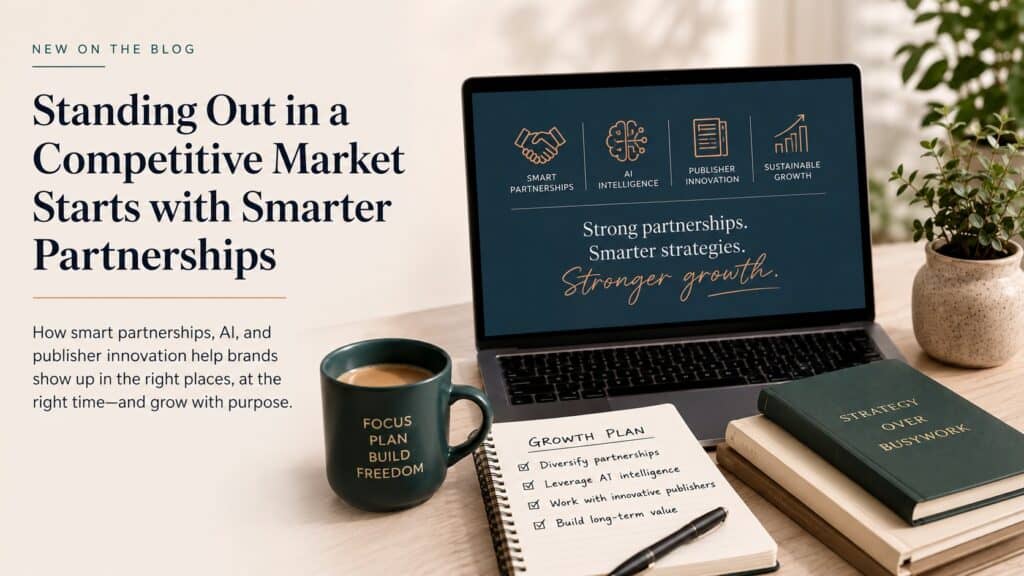
The brands gaining an edge are combining partnership marketing, AI and publisher innovation to reach customers throughout the entire buying journey, not just at the final click. Here’s what that actually looks like in practice, and how to build it into your growth strategy.
Build a portfolio, not a single channel
Relying on one marketing channel is one of the most common and most costly mistakes a scaling business can make. Search algorithms change overnight. Ad costs on Meta and Google have risen sharply, cost-per-click across major platforms increased by an average of 19% in 2025, and it gets worse year over year. Consumer behaviour evolves in ways that are hard to predict and harder to reverse. The founders who feel most exposed right now are the ones who built their growth on a single channel and are now watching that channel shift under them.
Partnership marketing offers a fundamentally more resilient approach. By working with creators, publishers, loyalty partners, review sites, technology partners and other trusted voices in your space, you diversify both how you reach customers and how you’re discovered, so no single algorithm change or platform policy can derail your growth.
The performance data here is compelling. Businesses frequently earn between $6 – $15 for every dollar invested in affiliate marketing, one of the strongest returns of any digital channel. Around 65% of retailers report generating up to 20% of their annual revenue through affiliate and partnership programmes. And more than 80% of brands now use some form of affiliate or partnership marketing to drive leads and sales.
For larger organisations, a diversified partnership portfolio means greater scale. For small and mid-sized businesses, and for female founders and women in business who are scaling without enterprise-sized budgets or venture capital backing, it is an opportunity to compete in the same channels as much larger brands, paying only for the results that actually materialise.
This is performance-based growth at its most practical: you build relationships with partners who have already earned the trust of your customers, and you pay them when those relationships convert. No wasted spend. No reach without results.
The partnership portfolio worth building includes several distinct types.
- Affiliate publishers: bloggers, comparison sites, loyalty and cashback platforms, media properties, who drive traffic and sales in exchange for a commission.
- Creators and influencers whose audiences overlap with yours, increasingly on performance models rather than flat fees.
- Strategic brand partners: other businesses serving your customer base, who can open access to audiences you’d otherwise have to build from scratch.
- Technology partners: platforms extend your distribution or enhance your data.
None of these require a massive upfront budget. All of them compound over time.
Let AI make you smarter
AI is changing how consumers discover brands, but it is also changing how marketers and businesses work. The best teams are not replacing strategy with AI. They are using it to work faster, uncover new opportunities and make better decisions with the data they already have.
This matters more than most founders realise. As of 2026, AI-powered search and discovery tools — Gemini, ChatGPT, Perplexity and even Claude — are increasingly where customers begin their research journeys.
When someone asks an AI assistant to recommend a product, a service, or a brand in your category, the results they get are shaped by what those systems have learned about who is credible, who is present, and who is being talked about by trusted sources.
Partnership marketing, specifically, having your brand mentioned and recommended by publishers and creators that AI systems recognise as authoritative, directly influences whether you show up in those results.
For marketers, AI is also transforming how partnership programmes are built and managed. As discovery expands beyond traditional search, brands need better visibility into where they currently appear and which partnerships are actually driving influence. This is harder to measure than a Google Ads dashboard, and historically it has required either a dedicated team or expensive third-party research to understand.
New tools are changing that. Awin’s AI Visibility and Smart Search tools, for example, are helping brands understand AI-driven discovery — specifically, where your brand is appearing in AI-generated results and recommendations — while also making it significantly more efficient to identify the right publisher partners for your category.
For a scaling founder or small business owner who doesn’t have a full performance marketing team sitting behind her, this kind of intelligence compresses what used to be months of research into something far more actionable.
The real advantage is not more data. It is knowing what to do with it. An AI tool that tells you which publishers are already talking about your category, which ones are adapting their content for AI-powered discovery, and which partnerships are generating the most influence for brands like yours — that’s the difference between building a portfolio strategically and building it by guesswork.
The founders and businesses getting ahead in this environment are the ones who treat AI not as a threat to their existing marketing approach, but as a new layer of intelligence to build on top of it.
Don’t overlook publisher innovation
Publishers have always shaped how consumers research and buy. What’s different in 2026 is how rapidly they are evolving, and how significantly that evolution affects what partnership marketing can do for your brand.
The most forward-thinking publishers are not just adapting their content for search. They are actively building for AI-powered discovery, structuring their content so that it surfaces in AI overviews, voice search results, and the recommendation outputs of tools like ChatGPT and Perplexity. They are also building increasingly specific and loyal audiences around particular topics, industries, and communities, which makes them more valuable as partners, not less.
A publisher with 200,000 highly engaged readers who trust their recommendations in your specific category is worth more to you than a mass-market media property with ten times the traffic and a fraction of the relevance. The shift toward niche, trusted, community-led publishers is one of the most significant structural changes in performance marketing right now, and it is one that female founders are well-positioned to capitalise on, because the communities you are building for are often exactly the kind of specific, values-aligned audiences that these publishers serve.
That makes innovative publishers more than just another marketing channel. They are strategic partners that help you build credibility with audiences who might otherwise take much longer to reach. They extend your brand into conversations you aren’t part of yet. They create proof points — the kind of third-party validation that AI systems and search engines increasingly look for when deciding what to surface. And they stay visible even as customer journeys continue to evolve, because their credibility is built on genuine audience relationships, not platform algorithms.
The question worth asking about your current partnership strategy: are you working with publishers who are building for where discovery is going, not just where it has been?
The takeaway
The brands that stand out are not chasing every new trend. They are building smarter ecosystems of trusted partnerships, using AI to make better decisions, and working with innovative publishers to stay visible wherever customers discover products.
For women in business who are scaling, this is one of the highest-ROI shifts you can make in your growth strategy. Not because it is easy or fast, but because it builds infrastructure that compounds. Every publisher relationship you build, every creator partnership you develop, every strategic brand partnership you launch makes the next one easier and the whole ecosystem more valuable.
Technology will continue to evolve. The platforms will keep changing. The algorithms will keep shifting. But sustainable growth will come from combining smart tools with strong relationships — because relationships, unlike platforms, are not subject to a single policy change.
That is where businesses of every size find their lasting competitive advantage. And it is where the most strategic female founders and women in business are already building.