
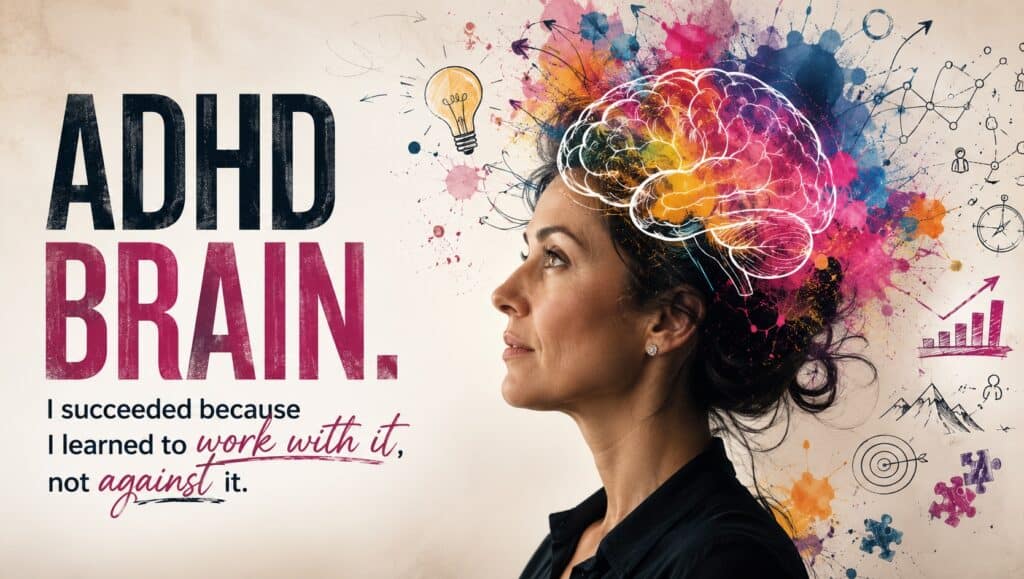
Can ADHD actually be an advantage in entrepreneurship? For me, yes — but not in the tidy, Instagram-caption way people mean. The same brain that made school a daily humiliation turned out to be almost perfectly wired for building a company from scratch. I didn’t succeed despite my ADHD brain. I succeeded because I learned to work with it, not against it.
I was a terrible student. Not a little behind, not “could try harder” — genuinely, consistently, painfully bad at school in almost every way the system measured success. I got kicked out of grade three French immersion for failing everything.
Imagine being eight years old and told you’re not smart enough to stay. I ended up at a scrappy public school on the wrong side of the train tracks instead.
I couldn’t memorize things. I couldn’t sit still. I couldn’t make myself care about subjects that felt disconnected from anything real. I lost things, forgot things, started projects with enormous energy and dragged myself to the finish line once the novelty wore off. I was told, in a hundred different ways, that I wasn’t applying myself. I got sent out of class often. Sometimes I just stood up and left. This happened all the way through to the end of my first two year college diploma.
What nobody told me — what nobody knew, or thought to look for — was that I had ADHD. I didn’t find out until my early 40s, years after I’d already become an entrepreneur. In the words of the doctor who diagnosed me, I showed “significant adult ADHD.”
I didn’t fully understand what that meant at first. I only got tested because my daughter was diagnosed, and I recognized the same telltale signs in myself.
When it finally clicked, something shifted — not just in how I understood myself, but in how I understood everything I’d built: my relationships, my temperament, my reactions to the world around me.
What School Couldn’t Measure
The first time I felt genuinely capable in an academic setting was at BCIT. The reason was simple: they didn’t ask me to memorize and regurgitate. They gave me real problems and asked me to solve them, collaboratively and creatively, with other people.
I thrived immediately — not because I’d suddenly become a different person, but because the environment finally matched my brain.
My group project, a concept for culinary tourism in BC, won the top award out of 300 students. We were offered jobs to execute it. I went from feeling like the least capable person in every classroom I’d ever sat in, to standing in front of a board of directors presenting an idea that worked.
I became the class spokesperson, a leader in the entrepreneurship program, and a mentor to other students. Today, I chair the Program Advisory Council for that same diploma program I graduated from at BCIT.
Nothing about my brain had changed. Everything about the context had.
That lesson — that the problem was never my brain, it was the container — has shaped every business I’ve built since. It’s also helps shape who I hire: people who think differently, who bring work ethic, quick problem-solving, collaboration and agility that others can’t match.
The ADHD Traits That Look Like Liabilities — And What They Actually Are
Let me be honest: ADHD is not a superpower in the tidy way people sometimes frame it. It’s genuinely hard. The disorganization is real. The overwhelm is real. The forgetfulness and the easy distraction are real.
But there’s also something true on the other side of it, and I think ADHD founders – and their stakeholders – deserve to hear both.
Hyperfocus. This is the one people talk about most, and it’s real. When something truly captures my interest — a topic, a person, a project — I can go deeper, faster, and further than almost anyone in the room. In the early days of AIM, that hyperfocus built client strategies that no one else would have had the intensity to produce. It’s not sustainable forever, but in bursts, it’s extraordinary and incredibly effective.
Pattern recognition at speed. ADHD brains are often scanning constantly, pulling in information from everywhere at once. We notice details and nuances others miss. In a fast-moving industry like digital marketing or technology, that ability to see connections others can’t is a genuine competitive edge. I can spot trends early, see partnership and ecosystem opportunities that aren’t obvious, and make lateral leaps that confuse people who think in straight lines.
High empathy and people-reading. Many women with ADHD develop an acute sensitivity to other people — partly from years of learning to read rooms to stay safe socially, partly from how our nervous systems are wired. In leadership, sales, and client relationships, this is invaluable. I could walk into a room and know within minutes what people actually needed, not just what they’d said they needed.
Genuine creativity and risk tolerance. The impulsivity that gets ADHD founders in trouble also makes us willing to try things more cautious thinkers won’t. Some of AIM’s best growth moves came from decisions I made fast, on instinct, before the analytical part of my brain could talk me out of them. Not all of them worked. But enough did, and I was lucky enough to have a team who would jump on my bandwagon with me.
The traits that made me a difficult student made me a successful founder. I just needed to learn how to work with my brain, not against it.
The Parts Nobody Romanticizes — And How I Actually Manage Them
I want to be completely honest here, because the “ADHD is a gift” narrative does a disservice to founders genuinely struggling with the harder parts.
The executive function gap is real. For me, starting things is easy. Finishing them is hard. Admin, follow-through, the unsexy operational work that keeps a business running — this is genuinely difficult for ADHD brains and requires real systems and real support to manage. The answer wasn’t to try harder. It was to align myself with people who could take this off my plate, hire for my gaps, build the external structures my brain couldn’t build internally, and stop expecting myself to operate like a neurotypical founder.
Rejection sensitivity is brutal. Many women with ADHD experience Rejection Sensitive Dysphoria — an intense emotional response to perceived criticism or failure that’s completely disproportionate to the situation but feels absolutely real in the moment. Often times it’s imposed by our own internal voice. In business, where rejection is constant and feedback is daily, this is exhausting. Learning to name it, expect it, and have a protocol for when it hits helped change things for me.
Burnout hits differently with ADHD. Because we can hyperfocus and push through on adrenaline and pain for extended periods, we often don’t notice the depletion until we’re completely empty. I’ve hit burnout more than once in my career, and looking back, my ADHD was a significant factor in all of them. The ability to ignore warning signals and keep going isn’t a strength when your nervous system is already running at 140%.
What I’d Tell Every ADHD Founder Right Now
You are not broken. You are not lazy. You are not “too much.” You are operating a high-performance engine that was handed an instruction manual written for a completely different vehicle.
The goal is not to become neurotypical. The goal is to build a business, a support system, and a life, that works with your actual brain — not the brain you were told you should have.
That means building structures that support your weaknesses so your strengths can run free. It means hiring and aligning with people who complement how your brain works, not duplicate it. It means being honest with yourself about when you’re in hyperfocus-genius mode and when you’re in depletion-and-avoidance mode, because the difference matters enormously for the decisions you make.
And it means finding community with other founders and allies who get it — who don’t need you to explain why you’re energized in a brainstorm and exhausted during admin week, who understand that the same woman who can close a six-figure deal on the phone sometimes can’t make herself open her email for three days.
That’s not failure. That’s ADHD. And you’re in good company. I’m right there with you.
5 Things That Genuinely Helped Me Build With an ADHD Brain
- Hire for your gaps immediately. Don’t wait until you can “afford” to. The executive function work that drains you is energizing for someone else. Find that person early — the ROI isn’t just financial, it’s your capacity to stay in the work only you can do.
- Build external accountability structures. Deadlines you set for yourself don’t always work. Deadlines attached to a real person — a partner, a coach, a peer group — usually do. Design your work around real accountability, not just willpower.
- Name your operating modes and protect them. Know when you’re in creative/vision mode versus execution mode, and batch your work accordingly. Don’t schedule a strategy session the same day as your financial review — your brain can’t context-switch without a cost.
- Create a capture system for every idea, immediately. Your brain generates fast and forgets fast. Voice memos, a single running notes doc, a trusted system that catches ideas the moment they arrive. The idea you had in the shower at 6am is gone by 9am if you didn’t record it. I keep a notepad beside my bed so that when I wake up with an idea in the middle of the night, I write it down immediately.
- Get the diagnosis if you haven’t. I know this sounds obvious, but for many women, ADHD goes undiagnosed for decades because we present differently, we mask more effectively, and the medical system wasn’t looking for us. Knowing changes everything — not because it fixes anything, but because it finally gives you the right map, and helps the people around you understand how you function differently.
The Bottom Line
I spent the first half of my life quietly ashamed of the ways my brain didn’t work like everyone else’s. I spent the second half learning to build around it, with it, and eventually, gratefully, because of it.
The company I built from a living room table, with $7 and an ADHD brain that school had written off, became one of the most respected in its industry. We won Company of the Year. I was named a Top 40 Under 40 and one of Canada’s Top 100 Female Entrepreneurs. We grew a Profit 500 and Growth 500 company from the ground up. We were acquired. We built something that lasted fifteen years and beyond, touching thousands of clients and partners, many of which were the largest brands in the world.
Every one of those accomplishments happened with my ADHD brain in the lead.
None of it happened because I learned to think normally. It happened because I stopped trying to, finally leaned into it, and surrounded myself with the systems and people who would support it.
If your brain works the way mine does — fast and scattered and deeply, intensely alive — you are not behind. You are not broken. You are not too much.
You are exactly the kind of founder the world needs more of. You just need the right container.
Keep going. You’ve got this. And if you’re on your own out there finding your way, come join us at Athena Collective – this is the new company I’m building with my co-founders and team so others like me don’t have to struggle so hard along the way.
See you there!
— Sarah